
Coastruction, the Future of Marine Life: 10 questions for founder Nadia Fani
What is the 10-questions interview? Regularly, we interview a promising startup or scale-up in the climate & energy tech ecosystem and ask them our 10 questions to showcase their technology, inspire the sector with their ambition and better understand their needs. With our platform (ZERO), we want to put these bold innovators on a pedestal and introduce them to our audience. Do you want to connect with this startup/scale-up, feel free to contact us at [email protected]!
1. Could you briefly introduce yourself, who are you and what makes you tick?
Nadia Fani, founder of Coastruction, combines a deep passion for 3D printing with a visionary approach to marine conservation and coastal protection. In this “10 Questions” interview, she delves into her transition from computer science to marine innovation, the mission of Coastruction, and how the company is transforming the maritime landscape with its sustainable, nature-inspired 3D-printed reefs.
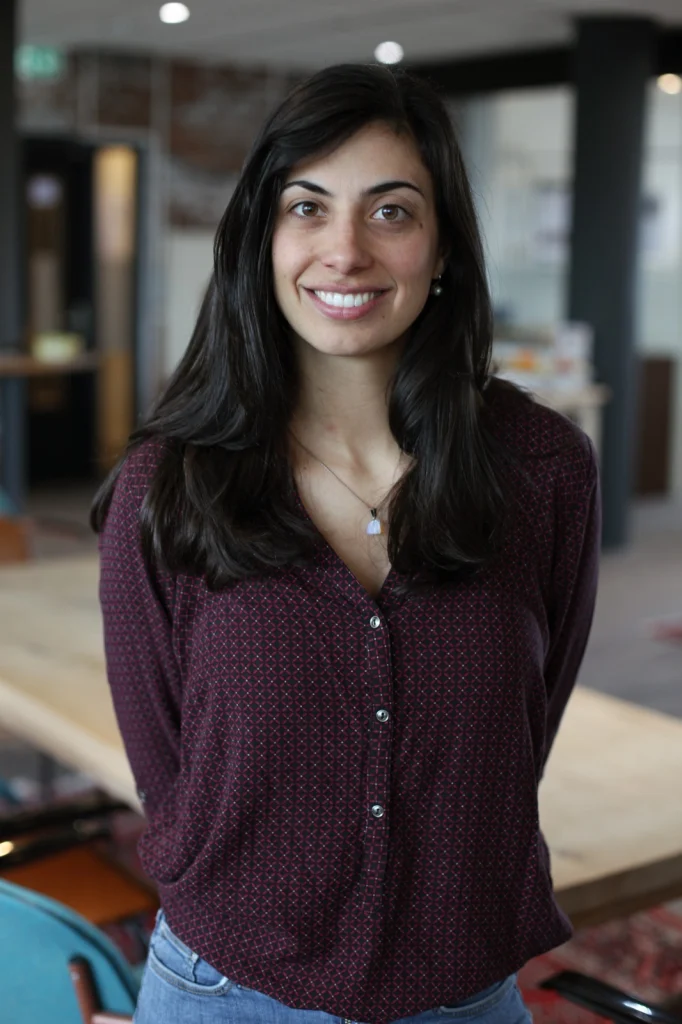
I’m Nadia, and I’m the founder of Coastruction, its technology, and its long-term vision. My background is in Computer Science, and before starting this journey I worked across several 3D-printing companies, helping develop and refine printing processes. But my fascination with making things began much earlier. I spent countless hours in my parents’ garage trying to assemble printers that could print with water, experimenting, failing, rebuilding, and learning. When I eventually discovered powder-bed 3D printing, everything clicked. I fell in love with the freedom of shape, the precision, and the possibility of creating large-scale structures that simply weren’t achievable with traditional methods.
What truly drives me, though, is my connection to the ocean. I grew up diving along the Tuscan coast, and over the years I watched those same waters change, places that were once vibrant and full of life slowly became quieter, emptier. Seeing that loss firsthand made it impossible for me to ignore the urgency of protecting and rebuilding our marine ecosystems.
For me, 3D printing isn’t just a technology. It’s a tool with the potential to give nature a second chance. Coastruction is where my technical skills and my admiration for the underwater world meet. Every day, I’m motivated by the idea that we can design and build structures that help marine life return, grow and thrive again.
2. What is the core of your mission (the bold goal) that you are pursuing?
The core of my mission is simple: to help restore and strengthen marine ecosystems at a scale that truly matches the urgency of the climate crisis. I want to use advanced 3D printing technology that we developed to create purpose‑built reefs that give marine life the habitat, shelter, and complexity it needs to thrive again
This work is about shifting restoration from slow, manual, small‑scale interventions to innovative, adaptable, and scalable solutions. By designing and printing complex ecological structures, I aim to make restoration faster, more precise, and more accessible to communities and ecosystems around the world. But also to demonstrate that we can develop technologies at a scale that it more suited to the pressing needs of the planet
Ultimately, my mission is to give the ocean a fighting chance. To combine technology, science, and passion in a way that brings damaged marine environments back to life and helps them stay resilient for generations to come.
3. What are you building/developing with your organization?
At Coastruction, we design and build our own powder‑bed 3D printers from the ground up. We began in 2021 with a small desktop prototype, Idefix, and have since scaled up to our first full‑size 1m³ printer, Asterix 1.0. Right now, we’re developing its larger 2m³ successor, Asterix 2.0. Every part of these machines, both hardware and software, is engineered in‑house by our team.
Our printing process is intentionally simple and sustainable, using only three materials: an aggregate (any type of sand), a marine‑grade cement binder, and water. A moving line of nozzles travels across a large box, spraying water onto the sand‑cement mixture as it’s deposited layer by layer. The pattern and frequency of the spray follow a digital design, which means we can print almost any geometry we imagine.
At the moment, our production is limited to 1m³ prints, but with the development of Asterix 2.0, we aim to scale up significantly in 2026. This growth will allow us to create larger, more complex structures and expand the ecological impact of our work.
4. What makes your team that you are working with, special?
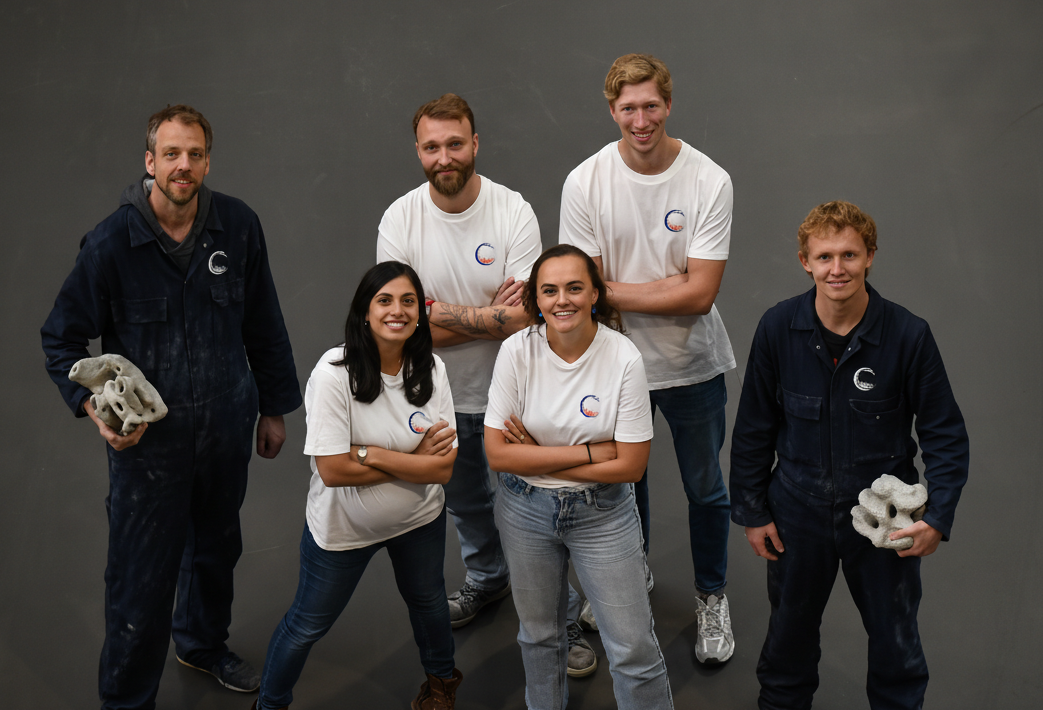
What makes the Coastruction team truly special is that every person is here because they’re genuinely passionate about the process, the mission, and the product. No one ended up at the company by accident, everyone chose to be part of this journey
Even though we all have our own professional titles, the reality is that everyone does a bit of everything. We switch hats constantly throughout the day, stepping into whatever role the moment requires. If something needs to be built, tested, moved, fixed, or figured out, someone jumps in, and often it’s not the person you’d expect based on their job title.
This flexibility isn’t forced, it’s part of the culture. We all understand that Coastruction is a small team trying to achieve big, ambitious goals. That means we naturally cross into each other’s boxes, learn new skills on the fly, and support one another without hesitation. It’s an unspoken agreement: we grow by being adaptable, curious, and willing to stretch beyond what we already know.
What ties it all together is a shared sense of ownership. Everyone feels responsible for the success of the work, not just their piece of it. That mindset creates a team that’s not only skilled, but resilient, collaborative, and genuinely invested in building something meaningful.
5. What is your view on our climate challenge and how do you want to contribute?
The climate challenges we face today won’t be solved with outdated approaches. These are modern problems that demand modern, innovative solutions. Our powder‑bed 3D printing technology is one of those solutions.
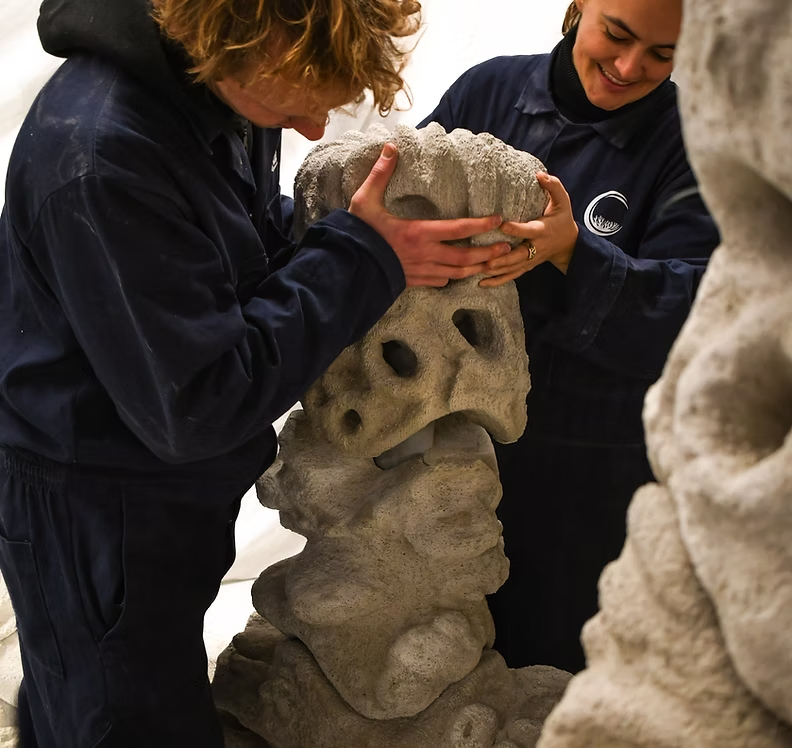
At Coastruction, our goal is to support the recovery and growth of marine ecosystems by creating surfaces and habitats where life can truly thrive. Because we can design, print, and deploy virtually any shape or structure, we’re able to tailor our work to very specific ecological needs — whether that means supporting a single species or strengthening an entire system. By placing these purpose‑built structures back into the ocean, we hope to restore balance in environments that have become fragile or degraded. It’s a way of using advanced technology not just for efficiency or novelty, but for regeneration, resilience, and long‑term ecological health.
6. What is your view on your sector and what is needed to accelerate change?
The marine restoration sector is at a turning point, whether it realizes it or not. We’re facing ecological challenges that are escalating faster than traditional methods can respond to. Coastal degradation, biodiversity loss, and the impacts of climate change demand solutions that are scalable, adaptable, and grounded in science. The sector is full of passionate people and promising ideas, but progress is often slowed by outdated tools, slow deployment methods, silly competitiveness and limited capacity to tailor interventions to specific ecosystems.
To accelerate real change, we need innovation that matches the scale of the problem. That means embracing new technologies (like powder‑bed 3D printing) that allow us to design and produce complex, functional marine structures quickly and efficiently. We need solutions that can be customized to local ecological needs, deployed at scale, and produced with materials that work with the ocean rather than against it.
Beyond technology, collaboration is essential. Scientists, engineers, policymakers, competitors and coastal communities need to work together instead of in isolated pockets. Clear regulations, accessible funding, and a willingness to experiment with new approaches will help the sector move from small pilot projects to large‑scale impact.
In short, accelerating change requires a shift in mindset: from slow, manual restoration efforts to innovative, data‑driven, and scalable methods. If we want to restore balance to fragile marine environments, we need to be bold, collaborative, and ready to rethink how restoration is done.
7. What are some recent highlights that really make you proud?
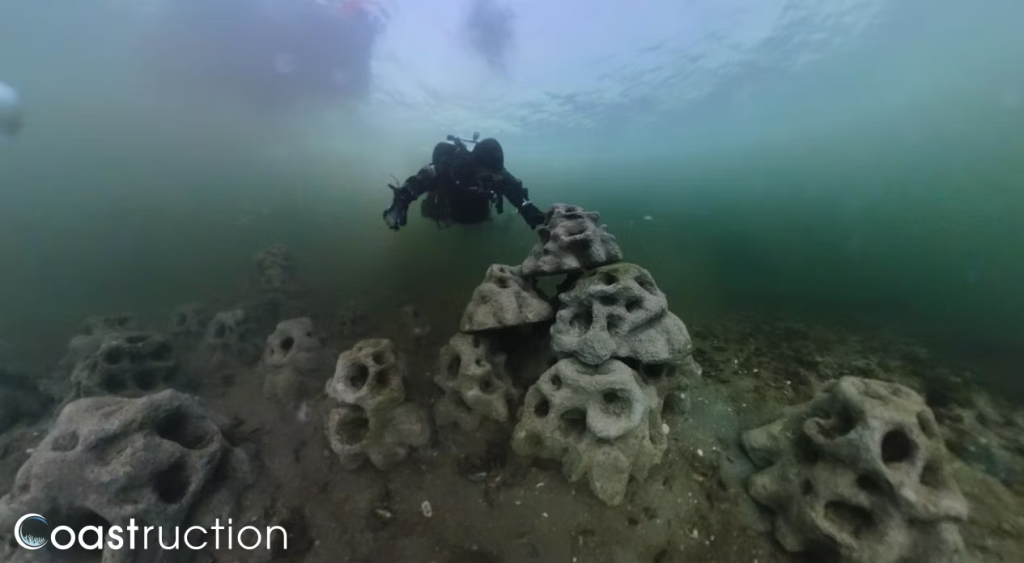
Recently, we reached several major milestones that mark an exciting phase of growth for Coastruction. In 2025, we completed our largest artificial reef deployment to date in the Red Sea, a 45 m² installation featuring 50 separate components, towering together over 2 meters tall. We also delivered our biggest single order of oyster reefs: 30 identical structures, each weighing 600kg, now placed along the Norwegian coast.
Internally, our team has grown as well. What began with three core full‑time members has expanded into a diverse group of four full‑timers, three part‑timers, and three students. This growth reflects both the increasing demand for our technology and the momentum behind our mission
8. What is the biggest challenge you see for your company to grow even faster?
One of the biggest challenges for Coastruction to grow even faster is securing the funding needed to scale our technology and deployment. Developing a larger powder‑bed 3D printer and deploying its products in marine environments requires significant investment. Growth is often limited by how quickly we can access the resources to build, test, and expand.
Another major challenge is acceptance. Powder‑bed 3D printing for marine restoration is still a relatively new approach, and many stakeholders are more familiar with traditional methods made in people’s back gardens. It takes time to demonstrate that our technology not only works, but often performs better: it’s faster, more adaptable, more precise, and capable of producing complex ecological structures that conventional techniques simply can’t achieve
Building trust in a new method is a process. We need continued validation, real‑world case studies, and strong partnerships to show that this technology is reliable, scalable, and impactful. As understanding and confidence grow, adoption will follow.
9. Are there needs (network, funding, people) that our community could provide?
Of course! There are several areas where support would make a meaningful difference. As a growing company working with innovative technology, we rely heavily on strong networks and shared momentum.
We desire access to a broader network of investors who understand the value of climate‑tech and are willing to back scalable ecological solutions. We also benefit enormously from supporters and storytellers who can help amplify our mission, explain why this technology matters, and bring more visibility to the impact we’re trying to create.
On the practical side, we’re always looking to connect with potential clients and partners who are ready to explore new restoration methods and integrate 3D‑printed marine structures into their projects. And of course, funding remains essential as it allows us to scale our printers, accelerate development, and deploy more structures in real ecosystems.
10. What are the 3 inspiring startups/scale-ups you think we should interview next?
1. Lobster Robotics
2. Tree Composites
3. Next Ocean
Enthusiastic about Nexus Energy or interested in this topic? Then contact us at [email protected]!

Leave a Reply