
Shore power: plugging ships into the energy transition
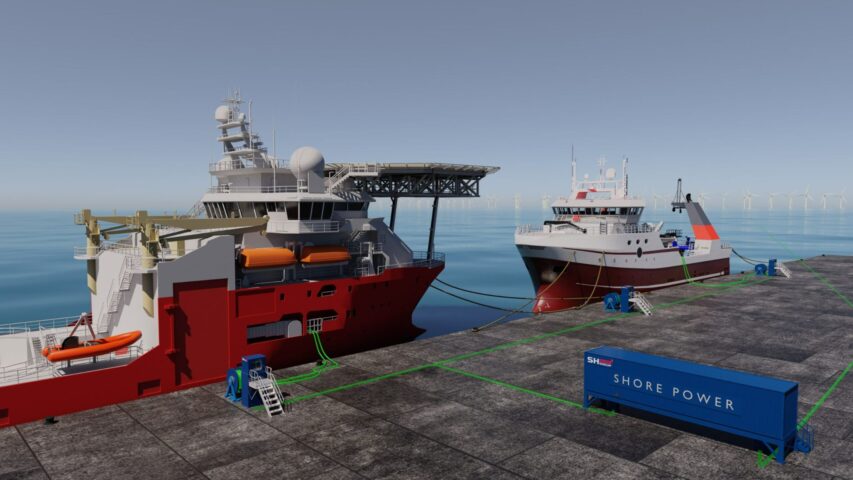
Image source: SH Group
Ports around the world are under growing pressure to decarbonise. In Rotterdam, that pressure is no longer just political or reputational: a new climate lawsuit argues that the Port of Rotterdam Authority must move faster to phase down fossil-fuel activities and the emissions they enable. Electrification is one of the few things ports can actually do about this today. Shore power is a clear example: supplying ships with electricity from the grid while they’re alongside, cutting emissions at berth now, and increasingly supporting the next generation of electric and hybrid vessels.
From cold ironing to charging
When a ship is in port, its work does not stop. Lights stay on, pumps run, refrigeration continues, cargo is handled, and crew and passengers still need power. Traditionally, that electricity has been generated onboard by auxiliary diesel engines, even while the vessel is stationary. As a result, ships continue to burn fuel and emit air pollutants while tied up at the quay.
Shore power changes that. Instead of running its own generators, a ship plugs into the local electricity grid and uses power from land. In large-scale applications such as cruise and container shipping, this is often called Alternative Marine Power (AMP) or cold ironing: a conventional ship connects to shore electricity while docked so that onboard diesel generators can be switched off, reducing local emissions, noise, and fuel use in port.
So far, most large shore power projects have focused on this use case: making existing ships cleaner while they are alongside. But shore power is beginning to mean more than that. As batteries become more common in ferries, workboats, and hybrid vessels, the same shore connection can also be used to charge onboard energy storage, not just supply “hotel” loads. For conventional vessels, the goal is primarily to stop burning fuel at berth. For battery and plug‑in hybrid vessels, that same interface can become part of the ship’s operational energy supply.
This is particularly relevant for ferries, e‑boats, water taxis, harbour craft and other vessels operating on short, predictable routes. They may spend only a few minutes in port, which means the charging system must be fast, reliable and well integrated into everyday operations.
Three ways to plug in
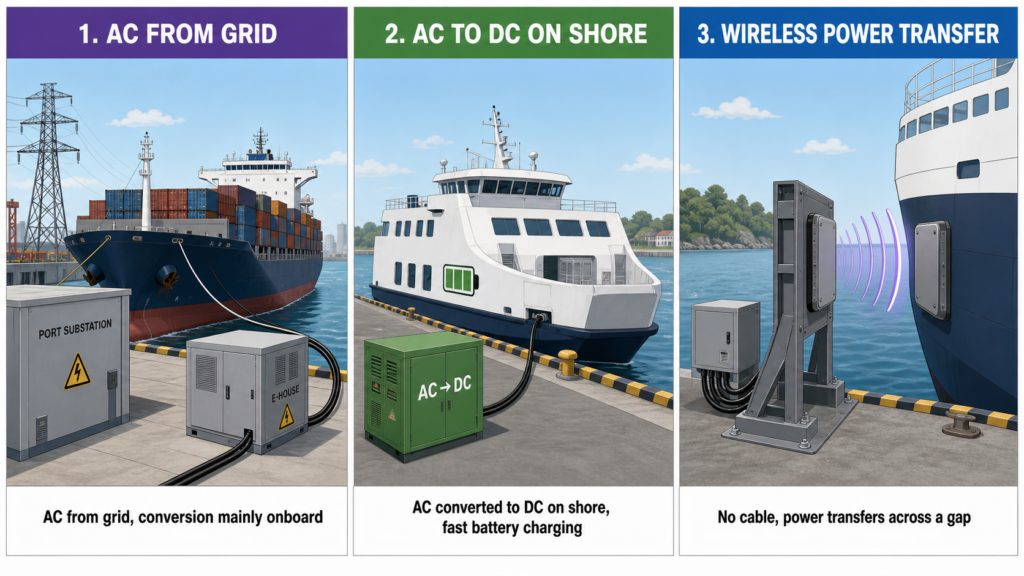
At a technical level, all shore connection systems aim to do the same thing: move electricity safely from the grid to the ship. The differences are in how power is delivered and where it is converted, and that determines whether a system is mainly used for cold ironing, for battery charging, or for both.
1. AC shore power: cold‑ironing standard
The first and most established option is AC shore power. The public grid supplies alternating current (AC), which is transformed and conditioned on shore and then delivered via a cable into the ship’s main electrical system. For many larger vessels, especially cruise and container ships, the existing switchboards and converters can distribute that power internally. This is the classic cold‑ironing setup: a conventional ship plugs into AC shore power while alongside so that its auxiliary diesel generators can be switched off.
On hybrid or electric ships, the same AC supply can also be routed through onboard converters to charge batteries, but in practice AC shore power is still used mainly to run hotel loads and port operations rather than to fast‑charge propulsion batteries.
Innovation around AC shore power focuses on making these systems easier and cheaper to deploy at scale:
- Companies like ABB and Zeppelin Power are offering modular, high‑voltage AC shore connection packages that can be dropped into existing terminals and adapted to different ship types.
- Cable and connector specialists such as Tratos and ESL Power Systems develop more compact, safer plug and cable‑handling assemblies designed specifically for harsh marine environments.
- Several providers are adding smarter monitoring and control layers so ports can manage multiple AC connections in real time and optimise when and how vessels plug in.
2. DC fast charging: built for batteries
The second option is Direct Current (DC) fast charging, designed specifically around battery‑electric and plug‑in hybrid vessels. In this architecture, more of the conversion work happens on shore. The grid feeds an onshore power conversion system, often in an e‑house or container, where transformers, rectifiers, cooling and protection equipment turn AC into DC at the voltage and current the vessel’s battery needs. The ship then connects directly to this DC interface, much like an electric car using a fast charger.
This approach is not typically used as a pure cold‑ironing solution for conventional ships, which are built around AC main switchboards. Instead, it is used to recharge propulsion batteries during short port calls. The advantage is that the vessel receives battery‑ready power and can charge quickly; the trade‑off is a more complex, tailored onshore installation.
A new generation of ferry startups is putting this to work. Norwegian company Hyke, a zero‑emission urban mobility startup, is one example. Its F‑15 electric shuttle has been running in public transport service in Fredrikstad. The result : cutting energy use by up to 88% compared to diesel ferries while relying on frequent shore‑based charging between short trips.
Innovation in DC fast charging is being pushed by other high‑frequency electric ferry projects:
Several pilots use battery‑buffered DC hubs on the quay: stationary batteries sit between the grid and the charger so vessels can charge at high power without creating extreme peaks on the public network.
In Bangkok, power‑electronics company ATESS has supplied 300 kW multi‑gun DC chargers so that a fleet of electric ferries can fully charge in around 20 minutes between trips.
In Amsterdam and other European cities, large manufacturers such as ABB and Danfoss are adapting high‑power DC charging technology from electric vehicles and industry to marine use, enabling new all‑electric ferry routes.
3. Wireless inductive charging : for frequent, short stops
The third option is wireless inductive charging. Instead of a physical plug, a transmitter pad mounted on the quay and a matching receiver pad on the hull are aligned across a small water gap; electricity transfers between them through electromagnetic induction. From the outside, this looks like a sturdy steel frame and flat pad on the quay facing a similar pad on the ship, often with a small shore‑side cabinet for cables and controls.
Today, this technology is almost entirely used for battery charging, not for general cold ironing. It is designed for vessels that dock frequently and briefly – such as electric passenger ferries or water taxis where fully automated connection saves time and labour.
Norway has become a key test bed for this approach. Norled’s hybrid ferry MF Folgefonn helped prove that high‑power wireless charging can work in regular service, and an electric passenger ferry in Fredrikstad reportedly performs roughly 150 inductive charging events per day with average stops of under two minutes. Companies such as Wärtsilä and ENRX are now commercialising these systems for harsh maritime climates, focusing on efficiency, robustness and alignment tolerances so that charging remains reliable even when the vessel does not dock in exactly the same spot each time.
Wireless concepts are also moving beyond ports. In the Norwegian Ocean Charger project, partners like VARD and SINTEF are developing multi‑megawatt magnetic charging systems that would allow service vessels to recharge directly at offshore wind farms instead of sailing back to port, using encapsulated coils to transfer power safely across an air gap even in open‑sea conditions.
The infrastructure and its constraints
Shore power is not just a ship and a cable. It depends on what sits behind the plug: grid connections, substations, conversion equipment, controls and safety systems on shore. In many projects these elements are packaged into e‑houses on the quay, which feed heavy‑duty cabling and connection systems such as pits, reels, masts or automated connectors.
This is also where many of the challenges sit. Ports need enough electrical capacity at the right berths, and in some regions grid congestion is already slowing down electrification projects. Space for transformers and converters can be scarce in busy terminals, while equipment has to withstand wind, saltwater, spray and vibration and still be safe and easy to use. Standards and automation are improving, but smaller electric vessels and new DC or wireless concepts do not always fit neatly into existing frameworks.
More than a cable
Shore power began as a way to make ships cleaner while they are in port, and cable‑based cold ironing is now relatively mature. High‑voltage AC shore connections are already operating in major ports, and DC cable charging for electric ferries is moving from pilot to daily use in places like Norway and the Netherlands. As more vessels adopt batteries and hybrid systems, the same plug that once only powered hotel loads is increasingly used to recharge the next voyage as well.
The frontier today lies in wireless inductive systems and tightly integrated charging concepts, where most of the new startups and pilots are emerging. Scandinavian projects with wireless ferry charging in Norway and experimental inductive systems for ferries and EVs in Sweden show how the region is pushing high‑power wireless technology into real operations. Companies such as Hyke, which builds fully electric urban ferries that depend on frequent shore charging, ENRX, which provides high‑power inductive pads for ferries and buses, and the Ocean Charger project led by VARD and SINTEF to enable multi‑megawatt offshore charging at wind farms, prove how younger firms and innovations are clustering around the newest parts of the value chain rather than the already established cable business.
For ports, this shift turns shore power investments into strategic energy choices: which ships they can serve, how they manage their grid connection and what kinds of charging ( AC, DC or wireless )they want to enable. For startups and specialised tech companies, it opens space around high‑power electronics, automated and inductive connectors, local battery buffers and software to coordinate charging across fleets, especially in early‑moving markets like the Nordics. Shore power is no longer just about plugging ships in; it is about plugging maritime transport into the wider energy transition, and deciding which mix of incumbents and new players will build the systems that make that possible.
References
ABB. (n.d.). Shore connection – electric solutions marine & ports. https://new.abb.com/marine/systems-and-solutions/electric-solutions/shore-connectionnew.abb
ABB. (2025). Shore‑to‑ship power – An effective solution for port emissions [Brochure]. ABB Marine & Ports.library.abb
Berth Electricity for Zero Emission in Ports (BREEZE). (2026). Berth electricity for zero emission in ports: Analysis of barriers and solutions [Report]. Interreg Europe.interregeurope
ENRX. (n.d.). Wireless inductive charging of ferries and vessels. ENRX. https://www.enrx.com/en/Induction-Applications/Inductive-charging-and-power-applications/Marine-and-shipsenrx
Hoff, B. (2019, January). Charging technology for small maritime vessels [Conference presentation]. Arctic Frontiers 2019. University of Tromsø. https://site.uit.no/ladeteknologi/wp-content/uploads/sites/375/2019/02/Arctic-Frontiers-2019-Bjarte-Hoff-169.pdfuit
IEC/IEEE. (2019). IEC/IEEE 80005‑1:2019+A1:2022+A2:2023–CSV: Utility connections in port – High voltage shore connection (HVSC) systems [Standard]. IEC/IEEE.nen
IEC/IEEE. (2023). P80005‑4: Utility connections in port – Part 4: Low voltage DC shore connection systems (LV‑DCSC) [Draft standard]. IEEE Standards Association. https://standards.ieee.org/ieee/80005-4/11275/standards.ieee
Indian Register of Shipping. (2025). Guidelines on shore connection systems on ships (Rev. 1). Indian Register of Shipping. https://www.irclass.org/media/7893/guidelines-on-shore-connection-systems-on-ships_rev-01_july-2025.pdfirclass
IndustryLinqs. (2026, April). Grid congestion Rotterdam port much less than feared, but problems remain. IndustryLinqs Energy. https://www.industrylinqs.com/energy/2026/04/grid-congestion-rotterdam-port-much-less-than-feared-but-problems-remain/linkedin
Nemko. (2020, June 9). Wireless technology has revolutionised ferry transportation in Norway. Nemko Blog. https://www.nemko.com/blog/nemkos-path-from-norway-to-the-world-0nemko
Platform Zero. (2025). Onboard carbon capture: How ships are becoming their own climate solution. Platform Zero. https://platformzero.co/onboard-carbon-capture-how-ships-are-becoming-their-own-climate-solution/platformzero
Port of Rotterdam Authority. (2020, October 13). Rotterdam presents ambitious shore‑based power strategy for sea‑going vessels. Port of Rotterdam. https://www.portofrotterdam.com/en/news-and-press-releases/rotterdam-presents-ambitious-shore-based-power-strategy-sea-going-vesselsportofrotterdam
Port of Rotterdam Authority. (2021, May 10). Shore power in Rotterdam. Port of Rotterdam. https://www.portofrotterdam.com/en/port-future/energy-transition/ongoing-projects/shore-power-rotterdamportofrotterdam
Ship Universe. (2025, December 15). Cold ironing made simple: 2026 update. ShipUniverse.com. https://www.shipuniverse.com/tech/cold-ironing-made-simple-2025-updateshipuniverse
TenneT. (n.d.). Connection services (Netherlands and Germany). TenneT. https://www.tennet.eu/node/1198relatics
Wärtsilä. (2017, September 19). Another world’s first for Wärtsilä: Wireless charging for hybrid coastal ferry successfully tested [Press release]. Wärtsilä Corporation. https://www.wartsila.com/media/news/20-09-2017-another-worlds-first-for-wartsila-wireless-charging-for-hybrid-coastal-ferry-succwartsila
Wärtsilä. (2023, September 12). Shore power solutions. Wärtsilä Marine. https://www.wartsila.com/marine/products/ship-electrification-solutions/shore-powerwartsila
Wärtsilä. (2024, May 22). Marine vessel charging systems. Wärtsilä Marine. https://www.wartsila.com/marine/products/ship-electrification-solutions/shore-power/chargingwartsila
Wikimedia Foundation. (2024). Shore power. In Wikipedia. https://en.wikipedia.org/wiki/Shore_powerwikipedia
Want to know more about Platform Zero? Contact us at [email protected] and we can tell you more about it!
