
Onboard carbon capture: How ships are becoming their own climate solution
30-04-2026
Imagine yourself as a shipowner. You have invested billions of euros in your fleet – vessels built to last decades. And now, carbon is becoming more expensive to dispose of. The EU ETS requires you to purchase carbon allowances if your ships exceed their emissions limits. Meanwhile, the IMO’s net zero target requires you to reduce your emissions by 50% by 2050, compared to the 2008 baseline. To future proof your business, your vessels have to be decarbonised to stay competitive in the transition toward cleaner shipping. The obvious answer? Alternative fuels. But switching involves many hurdles: engine modification, bunkering infrastructure, potential high fuel cost coupled with limited supply. This is where Onboard Carbon Capture (OCC) comes into play. OCC offers a transitional pathway for vessels to cut emissions while operating on conventional fuels, keeping you as shipowners stay on track with your net zero target. To gain insights why the technology matters, it helps to first understand what it is.
What is OCCS & its value chain
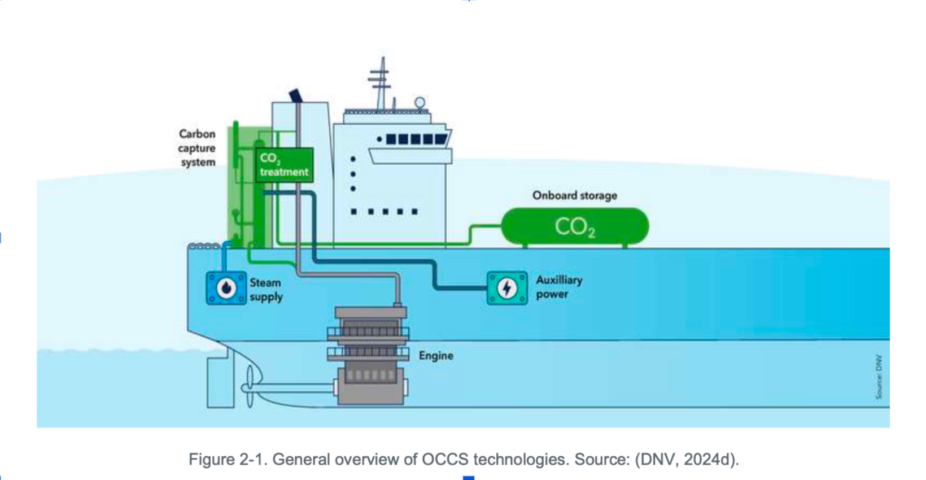
OCC allows vessels to capture CO2 directly from its exhaust gas stream before entering the atmosphere. The captured CO2 is purified, converted into an appropriate state before being stored on vessels and offloaded at designated facilities. It is further transported by ship, inland vehicle or pipeline for permanent underground storage or utilisation as feedstocks in various industries. OCC systems are designed for retrofitting or newbuilding, requiring minimal technical modification and allowing vessels to operate on fossil fuels.
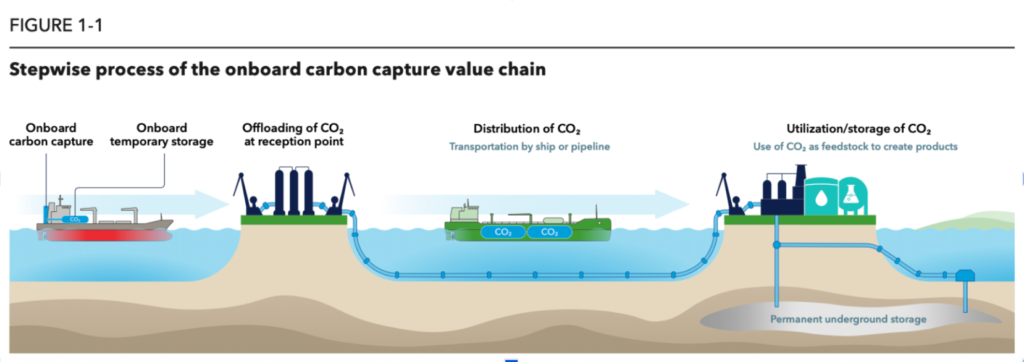
DNV white paper 2024
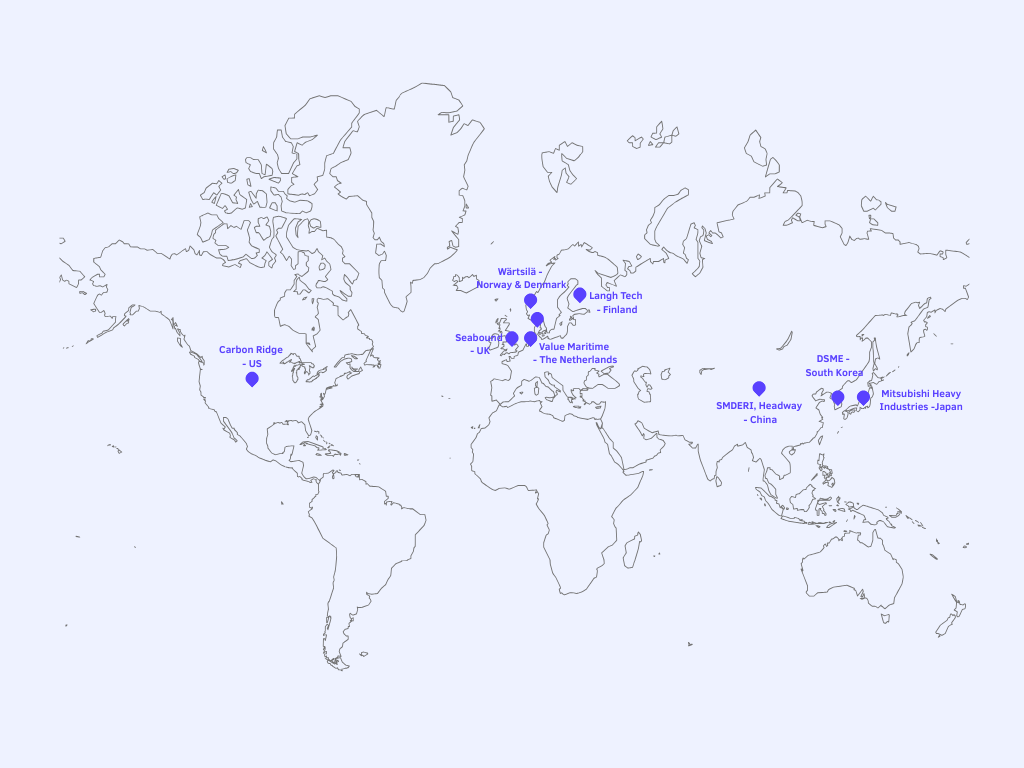
Given the promising decarbonisation pathways OCC technology offers, pilot projects have already been implemented, with most concentrated in North America, Europe and Northeast Asian countries such as Japan, China, and South Korea. The illustration below shows leading companies that develop OCC solutions across geographical locations.
Capture technologies & technical feasibility
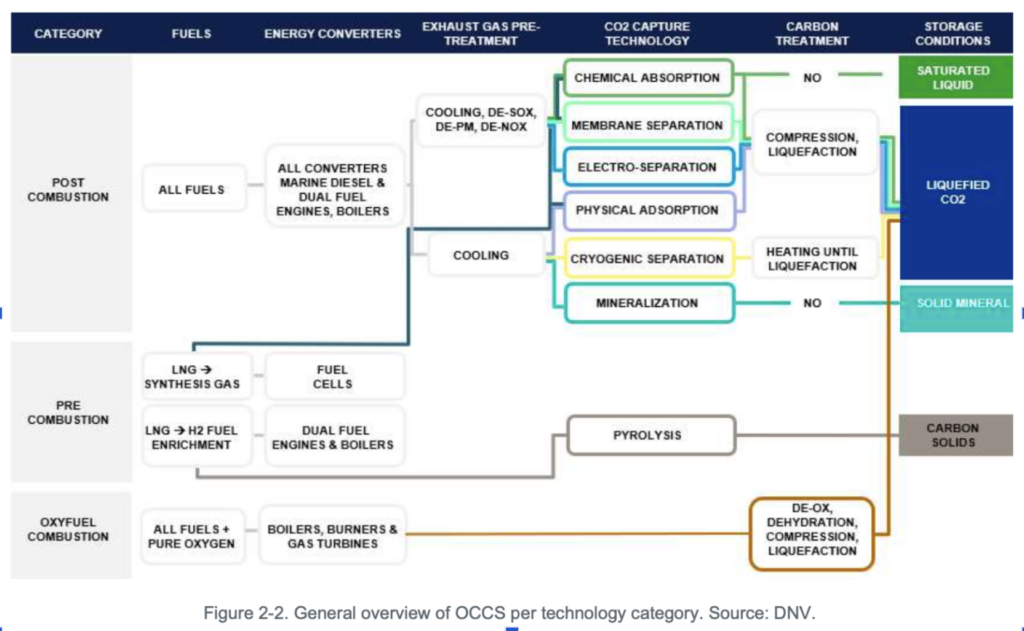
Similar to land-based Carbon Capture, Utilisation and Storage (CCUS), onboard carbon capture employs several methods classified as pre-combustion, post-combustion, and oxyfuel. Post-combustion technologies are the most widely adopted due to the maturity of the technologies as reported by EMSA. Among post-combustion capture mechanisms, chemical absorption and mineralisation methods have the highest number of installations in pilot projects due to their high capture rate. Captured carbon dioxide is stored in different states depending on the technology. For example, chemical absorption, and membrane separation often yield in liquefied CO2 while mineralisation permanently locks carbon in limestone.
Can OOC systems be installed on all ships? Not necessary. The suitability depends on several factors, including vessel profile and trading route as outlined in DNV’s white paper. OCC is best suited for large and medium-size vessels including tankers, bulk carriers, and containerships, given their high exhaust emissions and the available space required for system integration. Ships that have fixed trading routes with regular port calls offer consistent opportunities for offloading, making them suitable for OCC adoption. In fact, most current OCC pilot projects have been implemented on containerships as indicated in the EMSA’s publication.
The business of OCC is largely driven by avoiding compliance costs under the EU ETS. Average carbon prices under the scheme ranged between €65 to €75 per tonne in 2025 and are projected to rise to €140/tCO2 by 2030, €200/tCO2 by 2040 according to DNV’s Energy Transition Outlook CCS to 2050. Depending on the technology selected and the vessel’s operating region, shipowners also get revenue through CO2 utilisation & storage. With chemical absorption, liquified CO2 can be sold to greenhouse operators for €50 to €80 per tonne, while CO2 locked in limestone can serve as raw material for cement production. Permanent CO2 storage offers another revenue stream by generating carbon credits. Eventually economic viability depends on many factors like EU ETS carbon price, voyage route, capture technology, CO2 disposal costs, vessel type (newbuild or retrofit), and the type & price of fuel used. For various cases, OCC is an interesting solution to lower emissions and with the rise of carbon taxes and carbon prices, its attractiveness will only increase.
Challenges of OCC
The biggest challenge of OCC is the energy penalty – the additional fuel needed to account for the added weight of the entire system and the extra energy required to run it. According to DNV’s white paper, this ranges between 10-40%, depending on the technology and capture rate. The balance between capture rate and energy penalty remains challenging. Achieving a higher capture rate means more energy required, making the technology less attractive from the cost perspective.
Another challenge of capturing carbon on vessels is the high dependency on the broader CCUS value chain. After all, the disposal of captured carbon dioxide emissions happens inland, which depends on extensive networks of CO2 uptake services at multiple ports, available transportation vehicles and the readiness of sequestration sites. Currently, inland carbon hubs are limited, though it is expected to be improved as several ports including Rotterdam, Antwerp, Gothenburg, Gdansk, Dunkirk and Wilhelmshaven are developing more reception points (DVN). Furthermore, the physical state of CO2 requires the corresponding transport mode, with ship, rail, or truck typically resulting in higher transportation costs compared to pipelines.
It is noticeable that regulatory frameworks for OCC remain incomplete. The EU ETS is currently the only regulation that rewards ships for capturing carbon. The IMO began developing a framework in 2024, while FuelEU Maritime currently offers no credit for captured carbon. Furthermore, specific safety guidelines for OCC implementation have yet to be established by the IMO.
Highlight start-ups
Few start-ups currently offer OCC solutions. What is notable about these companies is that they employ different capture technologies alongside varied business models for downstream storage and utilisation options.
Carbon Ridge – A US-based innovator develops a chemical absorption system that captures post-combustion CO2 onboard with up to 75% capture rate. Their modular design resulted in a 75% spatial footprint reduction compared to conventional CCS systems. Captured CO2 is liquefied and offloaded either for permanent storage, generating carbon credits or for utilisation, which adds a revenue stream for shipowners.
Seabound – Founded in the UK, this company provides an innovative solution for ships to capture nearly 90% of CO2 from post-combustion using mineralisation technology. Exhaust gas passing through hydroxide-rich pebbles, triggering a chemical reaction that permanently locks carbon in limestone. This can be repurposed as raw material for cement production.
Value Maritime – This Dutch startup offers a retrofitted system that integrates with their “Filtree” SOx scrubber, capturing approximately 40% of CO2 using chemical absorption. The captured CO2 is stored in a “CO2 Battery” storage tank before being offloaded at Rotterdam Port and reused by greenhouses in the region.
Onboard carbon capture is a promising transitional solution, helping shipowners stay on track with decarbonisation targets while alternative fuels continue to mature. The technology is expected to deliver even greater impact when integrated into newbuilds. Wide adoption, however, will hinge on achieving low fuel penalties, competitive CO2 deposit costs, and harmonised regulations. Further research is needed to assess its commercial viability, long-term merit compared to switching to alternative fuels when it comes to meeting emissions targets.
Want to know more about Platform Zero? Contact us at [email protected] and we can tell you more about it!
